

Table of Contents
- How to Compare Online Therapy Options for Trauma
- Trauma-Informed Therapy Techniques That Research Supports
- Benefits of Teletherapy for PTSD and Trauma Recovery
- Signs of Professional Burnout in Missouri Helping Professionals
- How to Find a Trauma Therapist in Missouri
- Questions to Ask Before Starting Online Trauma Therapy
- Frequently Asked Questions
Last Updated: September 22, 2026
How to Compare Online Therapy Options for Trauma
Finding the best online therapy for trauma starts with knowing what to look for, not just what a website promises. Trauma therapy is different from general counseling. It asks for a clinician trained in specific methods, a clear safety plan, and a pace you can tolerate.
This guide from Life Balance Counseling walks through the questions that matter, the techniques research supports, and how to find a trauma therapist in Missouri who fits your life. We serve people across the state, from rural communities to the Kansas City and St. Louis areas.
A few things separate trauma-informed care from standard talk therapy. The therapist explains what to expect, checks in about your window of tolerance, and never pushes you to relive details before you’re ready. That pacing is not a luxury. It is the treatment.
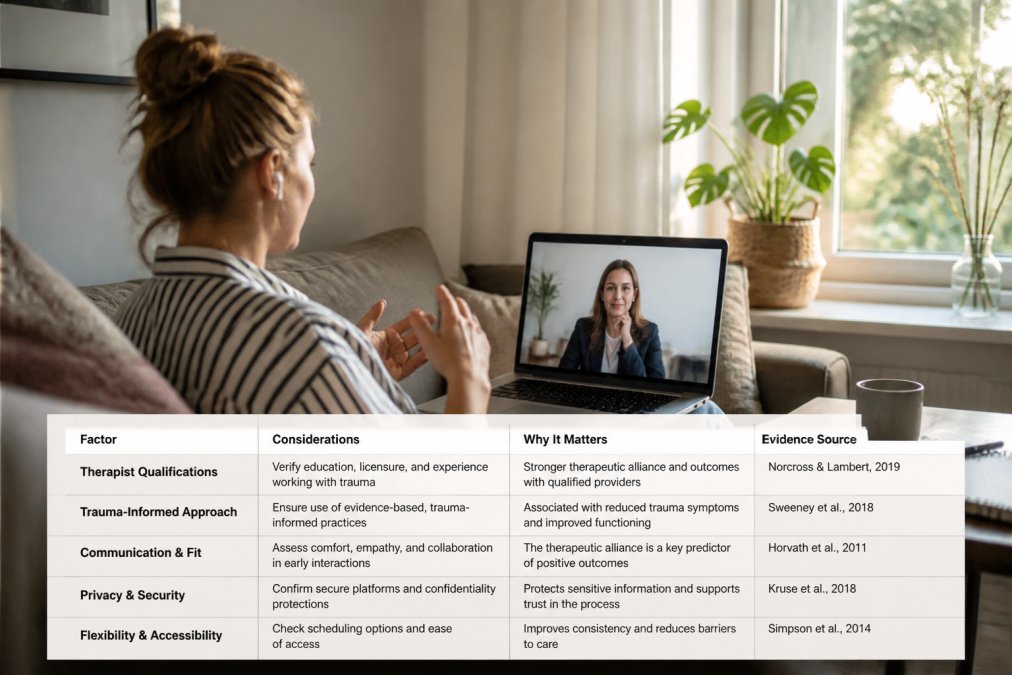
When you compare options, look at four things:
- Training: Does the clinician list trauma-specific methods, such as EMDR or parts work?
- Structure: Is there a plan for stabilization before deeper processing?
- Fit: Do they work with helping professionals, caregivers, or LGBTQIA+ clients?
- Access: Can you reach them from home, including in rural parts of Missouri?
| What to Check | Why It Matters | Warning Sign |
|---|---|---|
| Trauma-specific training | Shapes how sessions are paced | “We treat everything” with no focus |
| Stabilization first | Builds safety before processing | Diving into memories in session one |
| Scope of practice | Shows who they serve well | No clear answer on your concerns |
| Privacy setup | Protects confidentiality | No plan for a private space |
The SAMHSA National Center for Trauma-Informed Care outlines what trauma-informed care should include. Use it as a checklist when you read a provider’s website.
Trauma-Informed Therapy Techniques That Research Supports
Trauma-informed therapy techniques are approaches that prioritize safety, choice, and collaboration while helping you process difficult experiences at a manageable pace. Several methods have a strong evidence base.
EMDR (Eye Movement Desensitization and Reprocessing) uses guided eye movements or other bilateral stimulation while you recall a memory. It is one of the most studied treatments for post-traumatic stress. The American Psychological Association’s clinical practice guideline lists it among recommended options for PTSD.
Cognitive Processing Therapy helps you examine beliefs that formed around a traumatic event, such as “it was my fault” or “I can’t trust anyone.”
Parts work, sometimes called internal family systems, treats different parts of you with curiosity rather than judgment. Many people find it explains internal conflict better than willpower ever did.
Prolonged exposure gradually reduces the power of avoided memories, but it should only happen after you have coping tools in place.
A common mistake is choosing a technique before choosing a therapist. The relationship predicts more than the label on the method. Ask how they decide which approach fits you, and what they do when a session feels like too much.
Benefits of Teletherapy for PTSD and Trauma Recovery
Teletherapy for PTSD gives you access to specialized care without the drive, the waiting room, or the risk of running into someone you know. For people in small Missouri communities, that privacy matters.
Research summarized by the National Institute of Mental Health on PTSD shows that trauma-focused therapy can reduce symptoms, and studies of telehealth versions of these treatments generally find results similar to in-person care. The format changes, the work does not.
Practical benefits go beyond convenience:
- You can schedule around shift work, school pickup, or unpredictable on-call hours.
- You stay in your own space, which can make it easier to regulate afterward.
- You avoid time lost to travel, which matters in rural areas.
- You keep the same therapist even if you move within the state.
If you work in a small community, set up a private spot before your session. A parked car, a closed office, or a room with a white-noise machine all work. Decide this in advance so you are not scrambling at the start.
The trade-off is real: some people miss the felt safety of a shared room. If that describes you, say so early. A good therapist will adjust.
Signs of Professional Burnout in Missouri Helping Professionals
Signs of professional burnout in Missouri helping professionals often show up as competence, not collapse. Therapists, nurses, teachers, and first responders tend to push harder when they are running empty.
Watch for these patterns:
- You dread the work you used to love.
- You feel detached from clients, students, or patients.
- Small tasks take far more effort than they should.
- You are irritable at home and apologetic about it.
- Sleep does not restore you.
- You rely on caffeine, alcohol, or scrolling to get through the day.
- You tell yourself you are fine because you are still functioning.
The CDC information on work-related stress and burnout describes burnout as an occupational issue shaped by workload and system pressure, not personal weakness. That distinction matters. If the cause is the environment, individual effort alone will not fix it.
A common mistake is waiting for a crisis to justify support. By the time many helping professionals reach out, they have been running on fumes for a year or more. Reaching out earlier is not dramatic. It is maintenance.
How to Find a Trauma Therapist in Missouri
Knowing how to find a trauma therapist in Missouri comes down to filtering for training, fit, and access, then asking direct questions before you commit.
Start with these steps:
- Decide which methods you want to explore, such as EMDR or parts work.
- Filter for clinicians who name trauma as a specialty, not a side note.
- Check whether they offer online sessions so location is not a barrier.
- Confirm they are licensed to practice in Missouri.
- Ask about their approach to pacing and stabilization.
- Ask about cost and whether they accept insurance, then plan accordingly.
If you are in immediate danger or having thoughts of harming yourself, call 911 or contact the 988 Suicide & Crisis Lifeline. Therapy is not a crisis service, and reaching out for urgent help first is the right move.
Pricing varies by provider and session length. Ask each practice directly, and request a written summary of fees before your first session so there are no surprises.
If you are searching for a therapist near me, remember that online care counts. Life Balance Counseling offers online EMDR therapy and individual therapy to clients across Missouri, including rural communities where specialized trauma care can be hard to find.
Questions to Ask Before Starting Online Trauma Therapy
The right questions save months of trial and error. Ask them before your first session, not after.
- What is your training in trauma treatment? Look for specific methods and continuing education.
- How do you decide when we are ready to process a memory? The answer should mention stabilization and consent.
- What happens if I get flooded during a session? They should have a plan for grounding and closing safely.
- How do you handle privacy on your end? Ask about their platform and their own private space.
- What does progress look like, and how will we know? Vague answers here are a yellow flag.
- How do you work with helping professionals? If you are a therapist yourself, ask how they keep you from analyzing your own sessions.
- What is your cancellation policy and fee structure? Get this in writing.
The strongest predictor of whether trauma therapy helps is not the brand name of the method. It is whether you feel safe enough to be honest, and whether your therapist adjusts when you are not.
If you have tried therapy before and it did not stick, that is useful information, not a verdict. Tell your next therapist what fell flat. A tailored approach looks different from a generic one, and it starts with that conversation.
Many people in Missouri carry heavy work, trauma, and responsibility without ever getting support built for their situation. Life Balance Counseling offers online therapy designed for helping professionals, caregivers, and high-functioning adults, with trauma-informed care that includes EMDR and parts work, all from the privacy of your own space. Yael DiPlacido, LCSW, works with clients across the state, from rural communities to Kansas City and St. Louis. If you are ready to talk, request an appointment and take the next step at your own pace.
Frequently Asked Questions
Is online therapy effective for treating trauma?
Research, including studies summarized by the American Psychological Association and the National Institute of Mental Health, supports trauma-focused therapy delivered by video as comparable to in-person care for many people. What matters most is the type of therapy and the fit with your therapist, not whether sessions happen in an office or on a screen. If you are in immediate danger, call 911. For crisis support, contact the 988 Suicide & Crisis Lifeline.
What trauma-informed modalities should I look for in an online therapist?
Look for clinicians trained in specific, evidence-based methods rather than general talk therapy alone. Common trauma-informed techniques include EMDR, cognitive processing therapy, prolonged exposure, and parts work approaches. Ask directly which modalities the therapist uses, how they were trained, and how they decide which approach fits you. A good therapist will explain their reasoning in plain language and adjust as your needs change.
How do I know if online therapy is right for my specific trauma needs?
Teletherapy tends to work well if you have a private space, reliable internet, and a therapist licensed in your state. It may not be the best fit if you are in active crisis, need frequent in-person medical monitoring, or feel unsafe at home. Discuss your history and safety openly during a consultation. If you are in immediate danger, call 911 or contact the 988 Suicide & Crisis Lifeline.
What should I consider when choosing a therapist for trauma recovery?
Consider licensure in Missouri, training in trauma-specific methods, and how comfortable you feel during the first conversation. Ask about their approach to pacing, how they handle difficult memories, and what progress typically looks like. You can also ask about privacy practices. Take your time. Fit matters as much as credentials.


Leave a Reply